
Explosive Ordnance Risk Education (EORE) Course
Format
In-person
Course available in
English French
Duration
2 weeks
Design and implement effective, efficient, and safe EORE interventions for the context-specific challanges!
Aim
The training aims to equip EORE ‘coordinators/managers’ with a combination of knowledge, skills and attitudes (KSA) necessary to design and implement effective, efficient, and safe EORE interventions, aligned with IMAS and rooted in good practices. The curriculum will focus on key competencies essential for EORE coordinators/managers to perform their role and tailored to address context-specific challenge, in line with the EORE project’s outcome aimed at ‘reinforcing capacities for locally led and owned EORE responses’.
This training is aligned with the level 3 of the Competency standards for explosive ordnance risk education practitioners.
The term ‘coordinators/managers’ encompasses functions of EORE project/ programme coordinators, NMAC EORE officers, EORE team leaders and Mine Action Area of Responsibility coordinators.
What you will learn?
This training will strengthen participants’ capacity to:
-
Describe relevant normative frameworks and core EORE principles
-
Explain the links between EORE and global agendas
-
Understand mine action governance (architecture, strategy, standards and standard operating procedures -SOPs)
-
Apply good practices in quality and information management for EORE programme development
-
Use methodologies for contextual analysis and needs assessment
-
Apply risk assessment tools
-
Advocate for resource mobilization for EORE
-
Strengthen project management capacities
-
Design EORE interventions using an SBC approach
-
Apply good practices for coordination and integration of EORE interventions
-
Explain the basics of MEAL and apply them to the Theory of Change
Who should attend?
-
Senior and mid-level managers from the NMAA/NMAC who are responsible for leading, managing, coordinating or strengthening Explosive Ordnance Risk Education (EORE) and Conflict Preparedness and Protection (CPP) activities in the country.
-
Field staff, managers and coordinators from local, national and international mine action organizations who are responsible for planning, directing, managing, or supervising EORE/CPP activities.
-
Staff from other humanitarian and development organizations holding managerial or leadership positions with responsibility for designing, implementing, and overseeing EORE/CPP activities on behalf of their organizations.
Donors

General requirements
Recommended to take the Introduction to gender and diversity in mine action e-learning course OR مقدمة إلى النوع الاجتماعي والتنوع في الأعمال المتعلقة بالألغام .
A letter of support from your respective organization or centre nominating the applicant for the training course is required to be submitted at the time of application.
Mandatory e-learning courses to complete
Participants must have completed the following GICHD e-learning courses:
- Introduction to explosive ordnance risk education (EORE) essentials e-learning course OR مقدمة إلى أسس التوعية بمخاطر الذخائر والمواد المتفجرة
- EORE advanced e-learning course
Language level requirements
Participants should be able communicate and present on their national standards in English. The following standards of proficiency in English should be met (as described in STANAG 6001).
- Listening: good | 3
- Speaking: fair | 2
- Reading: fair | 2
- Writing: elementary | 1
Language requirements are compulsory and should be confirmed by applicants’ superiors.
Note: To facilitate the learning and communication process, simultaneous translation in Arabic language will be provided during the course, while English will remain the primary language of instruction for the course.
Equipment requirements
-
Computer with up-to-date web browser.
-
Google Chrome is recommended
-
Mobile phone
Computer Skills
-
You will be required to: work on course assignments using MS. Word, PowerPoint and other software.
-
Utilize word processing software
-
Enable audio and video settings on your device(s)
Teaching approach
-
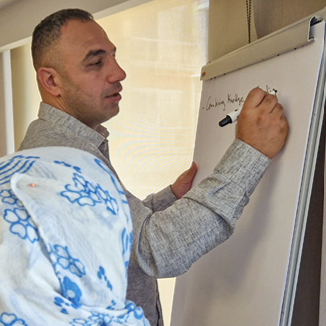
The training will be conducted in person, using a learner-centred approach. The programme combines theory and practice and includes assessments at three key stages: before, during, and after the course.
-
Sessions will take place in a classroom setting and use interactive teaching methods, including theoretical presentations, discussions, individual and group work, and collective practical exercises.
-
To reinforce the practical aspect, a fictional scenario will be used throughout the course. This scenario will serve as the basis for exercises allowing participants to draw parallels with their own EORE programmes and apply the knowledge gained.
Assessment
During the course participant performance will be evaluated. The overall grade for the course consists of 3 elements:
-
Active participation and involvement during the course: 10%
-
Final written test conducted in the classroom: 50%
-
Course assignment developments and presentation: 40%
-
Passing score: 70%
After a successfull completion of the course, you will be awarded with the certificate of achievement.
Currently, no training sessions have been scheduled. Subscribe to GICHD news alerts below to receive updates on new courses.