
Mr. Taban Joseph Augustine, Save Lives Initiative, South SudanThis course has given me essential knowledge to support the review of South Sudan's national technical guidelines, helping align our NMAS structure with IMAS standards. Collaboration with other countries, like Somalia, highlighted the importance of standard alignment and prepared me to contribute effectively to our review process.
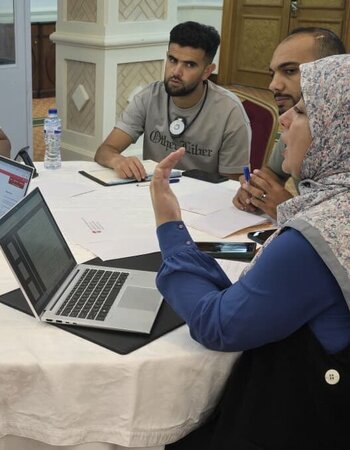
National Mine Action Standards (NMAS) Development Course
Format
Blended (In-person and Self-paced)
Course available in
English
Duration
4 weeks online + 1 week in person
Are you ready to help shape national mine‑action standards (NMAS)? This course gives you the skills and knowledge you need to contribute effectively to the development and management of NMAS.
Aim
This course equips participants with the skills to lead or effectively contribute to the drafting of new NMAS chapters, as well as the review and revision of existing ones. Upon completion, participants will be able to produce clear NMAS that align with IMAS, relevant normative frameworks, and national legislation, thereby enhancing the safety, efficiency, and effectiveness of mine‑action activities.
What you will learn?
This course walks you through every step of the NMAS development process and teaches the essential techniques for writing clear, effective standards. By the end of the course, participants will be able to:
-
Understand the roles and relationships of national mine action authorities. Mine action centres and key stakeholders
-
Incorporate relevant international legal obligations into NMAS
-
Structure and prioritise NMAS development or revision
-
Understand how to reflect risk management, information management and quality management in NMAS chapters
-
Clearly define and standardise mine action terminology within NMAS
-
Distinguish between IMAS, NMAS, and SOPs in terms of purpose and content
-
Draft clear, coherent, and effective NMAS aligned with IMAS principles
Key concepts including “all reasonable effort,” risk management, quality management, and information management will be examined in depth. By the end of the module, participants will appreciate how NMAS should define these supporting functions.
Who should attend?
-
a. Mine action officials and practitioners from countries affected by explosive ordnance contamination. Particularly those holding or earmarked to hold positions related to standards development/review. This includes operations officers and managers, EORE senior managers, quality management (QM), information management (IM) officers and managers. The course is also relevant to directors and deputy directors, especially those leading national programme start-ups.
b. Middle- to senior-level officials from mine action organisations and agencies, including representatives from donor countries and other relevant stakeholders. This includes UN advisors, technical advisors to National Mine Action Authorities (NMAAs), and INGO and NGO managers and officers who support NMAAs in the development of national standards.
c. Military officers and personnel. Those leading military demining units and responsible for the development of unit standard operating procedures (SOPs) or engaged in the development of National Mine Action Standards (NMAS).
General requirements
Recommended to take first:
Mandatory e-learning courses to complete
Selected participants are required to complete the following GICHD e-learning courses:
- Introduction to gender and diversity in mine action e-learning course
- Understanding the International Mine Action Standards (IMAS) e-learning course
- Introduction to explosive ordnance risk education (EORE) essentials e-learning course
Participants who fail to complete the e learning modules and the online phase requirements may be removed from attending the in person phase
Language level requirements
Participants should be able communicate and present on their national standards in English. The following standards of proficiency in English should be met (as described in STANAG 6001).
- Listening: good | 3
- Speaking: fair | 2
- Reading: fair | 2
- Writing: elementary | 1
Equipment requirements
Minimum Technology Requirements
- Computer with up-to-date web browser.
- Google Chrome is recommended
Computer Skills
- You will be required to: Navigate the web Interact with the GICHD Blackboard Learning Management System
- Utilize word processing software
- Enable audio and video settings on your device(s)
Teaching approach
The course is designed into three distinct phases as follows:
- Phase one: Online. (The online phase will start approx. 2 months before the in-person phase. The selected participants will be notified on the commencement details).
- Interactive self-study: articles, videos, quizzes, and e-learning components.
- Four virtual sessions with instructors - interactive virtual discussions and activities, bringing more depth to the subjects covered on self study.
- Phase two: In-person training: intense one week of learning the core modules and practically applying the knowledge and skills learnt on scenario based execises.
- Phase three: Practical involvement in NMAS development. (Hands‑on participation in the creation or revision of NMAS within a national mine‑action programme). In this phase you will lead or actively contribute to the development or review of specific standard chapters, working with minimal GICHD instructor guidance.
There will be an Impact assessment survey to be sent out 12 months after the training to enquire about the impact of the training on the individual and organisational performance. .
The following methods are used to make the learning journey the most effective and... enjoyable:
- virtual classes
- self-paced online study
- instructor presentations,
- Group discussions and group solution presentations
- Scenario-based group exercises.
Assessment
- During the course, participants’ performance in exercises and presentations will be evaluated. A final written assessment will be conducted at the end of the in‑person phase.
- An additional NMAS Development Achievement Certificate will be awarded after evaluation to those who proceed to the third phase. To obtain the certificate, you must submit a revised or new NMAS within six months of course completion.
What People are saying about this course


Mr. Abdulkadir Ibrahim Mohamed, Head of Information Management, Somalia Explosive Management Authority (SEMA)I joined this course to build skills for developing national mine action standards, and I'm grateful for everything we've learned. The introduction to writing these standards was especially valuable, as we recently started reviewing our own. I now understand the importance of including normative references, which will enhance clarity for readers.

Ms. Kidist Shumbeza, Information Management Officer, UNMAS, EthiopiaThe NMAS Development course was invaluable as Ethiopia begins drafting its national mine action standards. This training provided a unique opportunity to exchange experiences with other countries and actively engage in discussions. We've already set a plan to review and refine our drafts, applying the insights gained here.