
Just released
Assessment of Gender and Diversity Mainstreaming in Mine Action in Viet Nam Final assessment report
Addressing the consequences of explosive remnants of war is a humanitarian, developmental, and national defence and security priority of longterm significance for Viet Nam. Over the years, under the leadership of the Party and the...
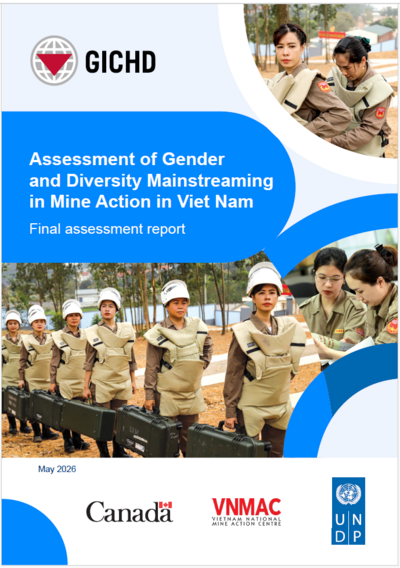
- Available in English, Vietnamese
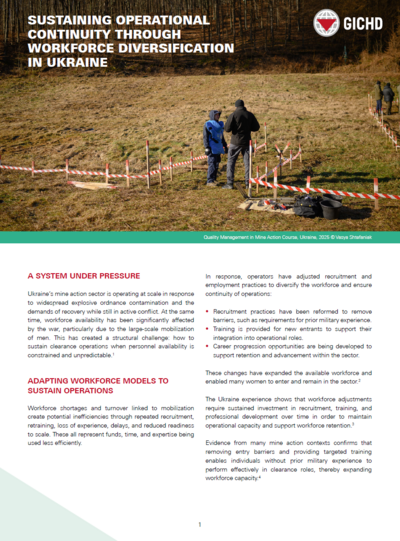
- Available in English, Ukrainian
The Socio-Economic Impact of Anti-Vehicle Mines in Angola
This pilot study depicts the impact of anti-vehicle mines (AVM) contamination on socio-economic development and the benefits of AVM clearance on sustainable development. The Sustainable Development Goals (SDGs) are used as a...
Guidance on Protection From Sexual Exploitation and Abuse
This publication is the result of a consultation process with partners both in Geneva and in mine-affected countries. It covers the drafting of sound protection policies, communication with staff and beneficiaries, holding...

Demining in urban centres is a race against time
Pascal Rapillard, GICHD Head of External Relations, Policy and Cooperation programme and Jérémy Repond, GICHD External Relations Officer, expand on how demining in urban centres is a race against time.

Achievements and new challenges in mine action
Ambassador Stefano Toscano, GICHD Director, expands on the achievements and challenges in mine action.

A Guide to Non-Technical Survey
Non-Technical Survey (NTS) is an important component of the Land Release (LR) process. NTS is the first operational step of the LR process and can be seen as the foundation for all subsequent LR activities.
This NTS Guide aims to...

- Available in English, Ukrainian
Global Mapping and Analysis of Anti-Vehicle Mine Incidents in 2018
This report presents and analyses AVM incident data from 2018. It follows up on and compares findings with earlier reports published by the GICHD and SIPRI examining AVM incidents in 2015, 2016 and 2017. Data in this report stem...

National Capacities and Residual Contamination (Croatia)
Croatia is affected by explosive ordnance (EO) contamination that consists of mines and, to a lesser extent, explosive remnants of war (ERW), including cluster munition remnants, caused by the legacy of four years of armed...

Key Performance Indicators and HMA Time to Standardize
Measuring performance is the norm across a range of human activities. But is it a norm in humanitarian mine action (HMA)? Some might suggest that it is. However, if we measure our performance, it is unclear whether we do so in a...

- Available in English
Long-Term Risk Management Tools and Protocols for Residual Explosive Ordnance Mitigation (Vietnam)
The Management of Residual Explosive Remnants of War (MORE) framework is a holistic long-term risk management (LTRM) approach for handling the reality of risks posed by explosive ordnance (EO). The current Geneva International...

Vietnam Ageing Study Management of Explosive Remnants of War (MORE)
Every conflict leaves behind explosive remnants of war (ERW) in lesser or greater quantities depending upon the nature and duration of the conflict and the types and quantities of weapons used. How ERW are dealt with reflects...
