
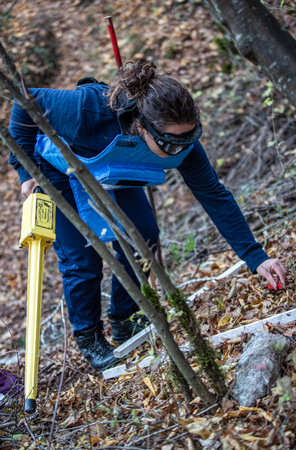
Delivering Inclusive Mine Action: Practical Approaches for Authorities and Operators
In Kenya Registration deadline: 5 March 2025 Location
Nairobi, Kenya Date
14 Apr 2025 to 25 Apr 2025
Duration
2 weeks
Language
English
Training Contact
d.wolsey@gichd.org
Location
Nairobi, KenyaDate
14 Apr 2025 to 25 Apr 2025
Duration
2 weeks
Language
English
Training Contact
d.wolsey@gichd.org
This programme is designed to help you become a powerful voice for mainstreaming gender, diversity, equality, and inclusion into your mine action working systems and practices.
Aim
This course aims to strengthen your ability to act as an effective gender focal point by building practical skills in gender and diversity analysis, advocacy, and mainstreaming within humanitarian mine action.
What you will learn?
The programme strengthens participants’ capacity to:
- Negotiate clear roles and well-defined responsibilities for gender focal points.
- Conduct desk-based gender and diversity analysis of the country, context or area of operation.
- Use the findings of the desk-based gender and diversity analysis to ensure that mine action operations are inclusive and effective.
- Conduct a mapping of their organisations’ policies, systems and practices to identify priorities for the mainstreaming of gender and diversity.
- Provide recommendations on how better to integrate gender and diversity considerations into strategic, operational, and employment policies, systems and practices.
- Develop and implement an evidence-based work plan for gender and diversity mainstreaming.
Who should attend?
- This course is designed for existing or prospective Gender and Diversity Focal Points, Inclusion Advisors, and mid- to senior-level managers from National Mine Action Authorities and Centres, international and national non-governmental organisations, operators, and other organisations engaged in national mine action programmes.
- To promote meaningful discussions and active engagement, the maximum number of participants that are accepted into the programme is 20.
- The GICHD is committed to gender equality, inclusivity, and providing equal opportunities. Women, persons with disabilities, and those from explosive ordnance affected countries are particularly encouraged to apply. If you need this information in an alternative format, please contact us and we’ll do our best to arrange it for you.
Impact stories
Donors


Mandatory e-learning courses to complete
Selected participants are required to complete the following GICHD e-learning courses:
- Introduction to gender and diversity in mine action e-learning course - the course aims to help learners identify where and why gender and diversity matter in mine action. The course is currently available in Arabic, English, French, Spanish and Ukrainian.
- Introduction to explosive ordnance risk education (EORE) essentials e-learning course - the course is currently available in Arabic, English, French, and Ukrainian.
Language level requirements
Participants should be able read, communicate, and present in English. The following standards of proficiency in English should be met.
- Listening: good | 3
- Speaking: fair | 2
- Reading: fair | 2
- Writing: elementary | 1
Language requirements are compulsory and should be confirmed by applicants’ superiors.
Equipment requirements
- Laptop or tablet recommended but not required for the in person training.
- Wi-Fi access and all course materials will be provided.
- Participants should bring appropriate clothing for in-door classroom activities and for outdoor activities. This should take into consideration the weather conditions at the time of year at the training location.
Teaching approach
The programme is built around a blended learning pathway, which takes place over a 12-month period:
E-learning courses
- Participants in the programme are required to complete the e-learning courses, prior to the in-person training.
In-person training
- The 10-day training aims to equip participants in the programme with the skills required to effectively mainstream gender and diversity in the policies, systems and working practices of mine action operators and national mine action authorities. The training is highly interactive and participatory and adopts a scenario-based approach which is built around group work, pair work, individual reflection, debate, experience sharing, and practical exercises. The training integrates a range of different communication tools, such as animations, videos, picture analysis, case studies, and much more.
Community of practice
- Participants who have successfully submitted at least one assignment will be invited to join a Community of Practice. The Community of Practice will provide an opportunity for continued learning, sharing experiences, presenting activities undertaken after the in-person training, and offering peer support.
Assessment
- Participants are required to submit up to three assignments following the in-person training. These assignments are linked to the expected outcomes of the programme and provide an opportunity for the participants to put into practice the knowledge and skills they have acquired in their place of work.
- The assignments are adapted for each trainee based on their work thematic and the identified gender and diversity mainstreaming priorities of the organisation. These priorities must be agreed between the participant, their manager and their designated GICHD support role.
Travel & Accommodation
- GICHD and the Humanitarian Peace Support School (HPSS) will provide necessary administration and logistic support for up to 15 selected participants. The GICHD will provide accommodation within the International Peace Support Training Centre (Nairobi, Kenya) including meals, coffee breaks, classroom materials, etc.
- The GICHD offers travel sponsorships for a maximum of two relevant representatives from each national mine action authority and other partners that do not have the financial means to cover their participation and if the need is justified. In these cases, the GICHD will provide support in the form of air tickets. The transfer to and from Nairobi airport will be provided by HPSS.
- A support letter from the participant's employer must be attached to the application, along with a colour passport copy valid for at least 6 months from the date of entry to Kenya.
- Selected participants must have valid and adequate health, hospitalisation, accident, and repatriation insurance coverage in Kenya for the period of stay.
- The GICHD does not provide any insurance or expenses for health care, accident or accident liability for the duration of the training.
Location
Nairobi
Kenya