
Meet Sahar Ahmed, Data Analyst and Gender Focal Point, Yemen Mine Action Coordination Centre (YMACC)
I Did Not Choose Mine Action – Mine Action Chose Me
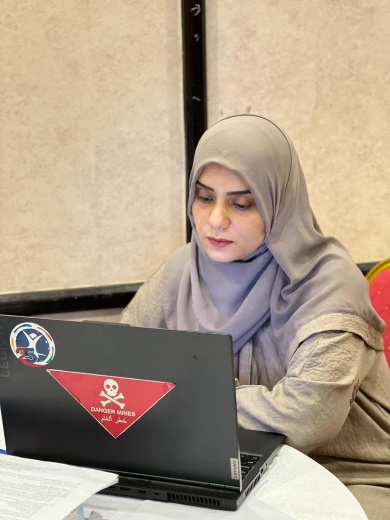
This is the first time I’m sharing my story. Nobody at my workplace knows about this. My colleagues often ask me, “Why are you invested in mine action, Sahar?” The answer lies in a moment from my childhood.
In 1994, I was in the third grade. I clearly remember an Explosive Ordnance Risk Education (EORE) session at school, where they showed us a poster. The poster warned children about the dangers of touching suspicious objects, unexploded ordnance, and other explosive items — and the dangerous behaviors associated with them. The message was clear: “Don’t touch!” That message still echoes in my mind today.
I was an obedient child, and I followed the instructions. That simple but powerful information saved my life. I believe that early experience planted the seed of my commitment to mine action. It instilled in me a deep responsibility to ensure that other vulnerable groups — like the child I once was — receive the same life-saving messages.
The role of the Gender and Diversity Focal Point did not officially exist before. However, after I was nominated to attend the “Regional Training Programme for Gender and Diversity Mainstreaming in Mine Action” held by the Geneva International Centre in July 2023, the vision began to take shape. The training helped translate the concept into reality, and I was officially appointed to this role.
Today, as a Data Analyst and Gender and Diversity Focal Point at the Yemen Coordination Mine Action Centre, I carry that sense of responsibility in everything I do. One of the recent highlights of my work was suggesting updates to some of the data collection forms to better integrate gender and diversity considerations. I worked closely with the Information Management team to implement these changes, and together, we successfully disaggregated the data by age, gender, and other key diversity dimensions — in line with the International Mine Action Standards (IMAS). This was a crucial step toward more inclusive and effective programming.
I also led a training course on gender and diversity. But to be honest, addressing these topics hasn’t always been easy in Yemen. At first, I faced resistance — many people were hesitant to embrace change.
Instead of giving up, I focused on demonstrating the practical benefits of being gender and diversity responsive, both in the short and long term. I helped my colleagues visualize how inclusive approaches could improve results across the entire mine action programme. Little by little, their perspectives began to shift, and many became strong supporters. Today, many of these strategies have been formalized and are now embedded in the rules and procedures of Yemen’s mine action framework. For me, this is not just a professional achievement — it’s a powerful reminder that change begins with a single step... and a firm belief.