The GICHD Gender Focal Point Capacity Development Programme helped build sustainable capacity for gender and diversity mainstreaming in the mine action sector. Participants acquired the knowledge…
The GICHD Innovation Conference 2025 has successfully concluded, bringing together experts dedicated to reducing the risks posed by landmines, cluster munitions, and other explosive ordnance that…
In the mine action sector, as in so many others, efficiency is a central concern in operations. Efficiency in mine action is defined as a measure of how economically resources/inputs (funds,…
The GICHD supports the timely and effective implementation of the international treaties that guide policy and practice in mine action. It does so by bringing evidence, experiences, and good…
Introduction The GICHD issue briefs and statements listed below contribute to substantive discussions in mine action and ammunition management. Follow the GICHD on social media and check back here…
A set of global guidelines has been developed to document good practice in mine action and to aid their translation into national standards. Mine action standards have been developed to improve…
Land Release uses an evidence-based approach to more accurately differentiate between those areas that require clearance and those areas that do not. The process of gathering evidence…
Strategic Planning in Mine Action Mine action takes place in conflict or post-conflict contexts by a range of national and international governmental and non-governmental actors. The process of…
Contaminated countries need a wide range of support to meet the challenges posed by explosive ordnance (EO), from capacity sharing across a range of topics, through to developing tailored solutions…
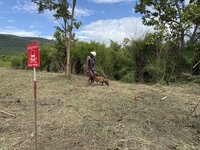
Clearance of landmines and Explosive Remnants of War (ERW) is a challenging, time-consuming and expensive activity utilizing manual deminers and the support of Animal Detection Systems (ADS),…