
Just released
Strengthening effectiveness through safeguarding and accountability in South Sudan
South Sudan faces high levels of sexual and gender-based violence (SGBV). Entrenched gender inequalities, weak institutions and legal systems, discriminatory social norms, and limited access to healthcare and justice services...
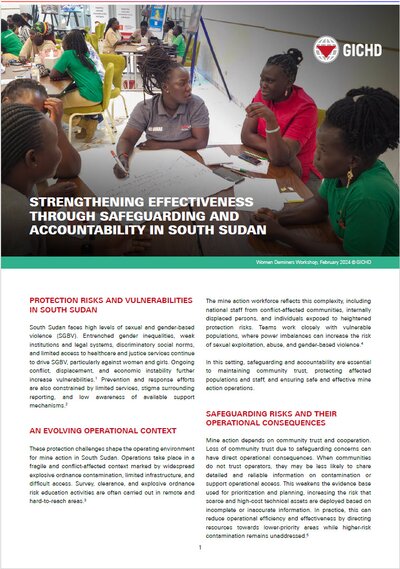
- Available in English
Land Release Research Agenda
Research agendas, developed under the Mine Action Innovation Hub, serve as practical guides that outline key research needs and provide stakeholders with an evidence-based foundation for setting research priorities. This edition...
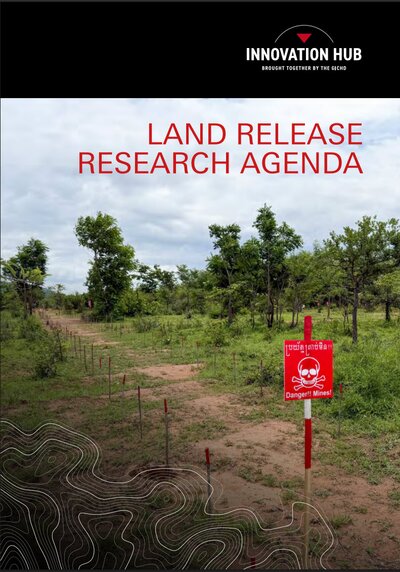
- Available in English
État d'avancement de la gestion sûre et sécurisée des munitions
La reconnaissance de la double menace d'une mauvaise gestion des munitions conventionnelles en termes de prolifération incontrôlée et d'explosions dévastatrices a de plus en plus renforcé l'importance de la gestion sûre et...
- Available in French
Global Mapping and Analysis of Anti-Vehicle Mine Incidents in 2017
This report presents and analyses AVM incident data from 2017. It follows up on and compares findings with earlier reports published by the GICHD and SIPRI examining AVM incidents in 2015 and 2016.
Data in this report stem from...
- Available in English
Lessons from the Past: The Rapid Clearance of Denmark's Minefields in 1945
The clearance of the vast majority of Denmark’s minefields during 1945 was remarkable. In just under five months, a force ranging between 750 and 2,600 German prisoners of war (POW) under the supervision of 250–350 Danish officers...

- Available in
Zimbabwe National Mine Action Strategy 2018-2025
This National Mine Action Strategy, the first of its kind in Zimbabwe, presents the overall vision, mission, goals and objectives of Zimbabwe’s mine action programme for the period 2018-2025. The strategy’s timeline corresponds to...
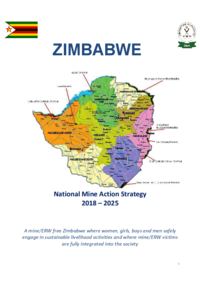
- Available in English
The Challenge of Long term Risk Management in Mine Action
This article briefly explores how states affected by landmines and explosive remnants of war (ERW) are faced with a number of difficult decisions when they establish their mine action program.

- Available in English
The Collaborative ORDnance Data Repository (CORD)
This article briefly explores The Collaborative ORDnance Data Repository (CORD) that has been in existence since 2015. A database of over 5,000 entries detailing a wide range of explosive ordnance.

- Available in English
Improvised Explosive Devices and the International Mine Action Standards
This article briefly explores how improvised explosive devices (IED) are not new in mine action; they have contributed to explosive ordnance contamination in post-conflict settings since the advent of humanitarian demining almost...

- Available in English
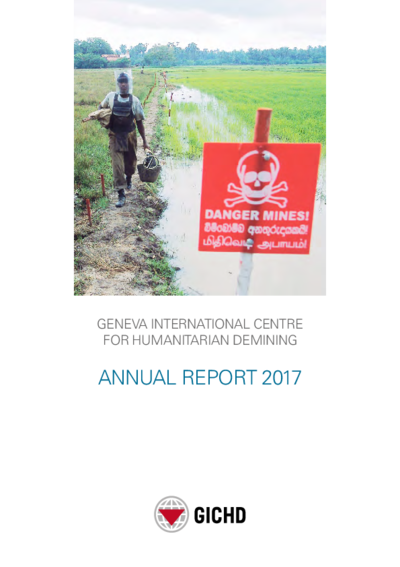
National Capacities And Residual Contamination | Albania
This case study forms part of a broader GICHD study on national capacities and residual contamination. The purpose of this report is to document Albania’s experience of developing national systems and capacities to address...

- Available in English
Prioritisation Policy, Procedures and Practices Relating to UXO Clearance in Lao PDR
This report maps the current prioritisation system in Lao PDR, including UXO policies and related development policies of the Government of Lao PDR (GOL), standard operating procedures of UXO operators, and actual prioritisation...

- Available in English