
FOREWORD
Mine action is, by definition, a collective effort. By working together, we strengthen systems that endure. We build confidence. And we increase options for people facing explosive ordnance risks so that they can live in safety.
As global conflicts intensify, the threat posed by landmines, cluster munitions, and other explosive ordnance continues to grow. Today, over 100 million people across more than 60 countries and territories live with the risks caused by contamination. Civilians account for more than 90 per cent of recorded casualties, with children among the most affected.
The consequences of explosive ordnance are felt irrespective of borders, politics, or identities, impacting communities and countries for years or even generations. Its effects are felt throughout communities and countries and across generations. Explosive ordnance kills and injures. It restricts movement and undermines livelihoods. It shapes daily choices in visible and invisible ways.
Mine action, however, offers a response. It is grounded in the fundamental principle that safety, dignity, and access to land should not depend on where a person lives, who they are, or which emergency has the world’s attention.
Read more
In 2025, we witnessed a divided world: crises were numerous, resources were under greater strain, and the presence of explosive ordnance spread across conflicts, cities, and communities, with devastating consequences for civilians. At the same time, multilateralism and international law faced significant pressure as several countries withdrew from the Anti-Personnel Mine Ban Convention (APMBC). Despite these challenges, the Geneva International Centre for Humanitarian Demining (GICHD) continued its work to protect civilians from landmines and other explosive ordnance.
• Regional approach: A regional approach guided much of our work fostering dialogue, knowledge exchange, and cooperation among affected countries. In 2026, the GICHD will establish an office in Jordan, allowing more agile and sustained engagement in the region. In 2025, therefore, we prioritized the strengthening of local capacity, the development and review of international norms and standards in both mine action and ammunition management, and the reinforcement of long-term partnerships.
• Innovation: Research continued to drive advances across the sector to address technical challenges, including those related to underwater explosive ordnance and liability in mine action. The GICHD Innovation Conference, held in Luxembourg for the first time in 2025, promoted solutions tailored to the situations faced by deminers and affected communities. The inaugural Innovation Award recognized promising ideas and encouraged new partnerships. Similarly, the launch of our Innovative Finance Secretariat marked an important step in designing finance mechanisms tailored to mine action.
• Ukraine: Our work in Ukraine continued to expand. Following the launch of the country’s National Mine Action Strategy 2024–2033, we facilitated a review workshop, with the Ministry of Economy, Environment, and Agriculture, that confirmed substantial progress and the achievement of several key targets.
Mine action is, by definition, a collective effort. By working together, we strengthen systems that endure. We build confidence. And we increase options for people facing explosive ordnance risks so that they can live in safety. As we look ahead, we draw inspiration from our partners, donors, and colleagues worldwide, particularly those working on the front lines to make communities safer. We are deeply grateful for the generous support of our donors and for the commitment, expertise, and continued engagement of our partners.
Dr Barbara Haering, GICHD President
Ambassador Tobias Privitelli, GICHD Director

Dr Barbara Haering,
GICHD President

Ambassador Tobias Privitelli,
GICHD Director
GICHD IN NUMBERS
2025 STORIES
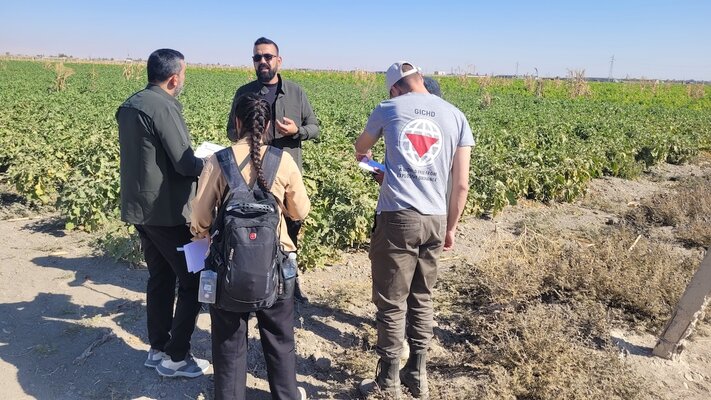
Working alongside national partners in Syria
Over the past year, Syria has seen a sharp rise in incidents involving explosive ordnance, with occurrences nearly every day.
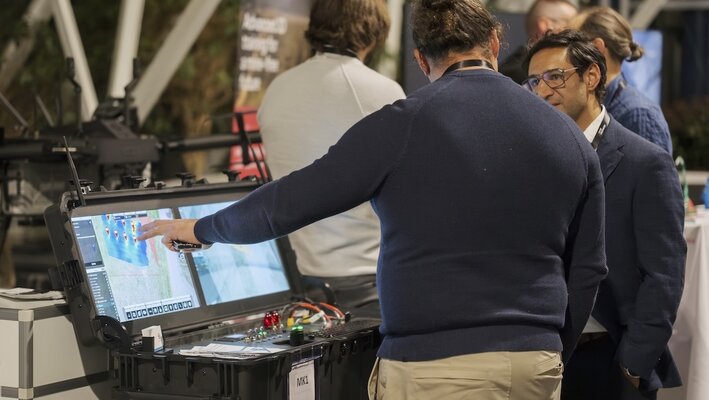
Strengthening innovation at the GICHD
Our sector is at a crossroads: needs are increasing, with more than 60 countries and territories affected by landmines, cluster munitions, and other explosive ordnance, while funding and capacity continue to decline.

Partnerships driving progress in Ukraine
Since the full-scale invasion of Ukraine in 2022, landmines, cluster munitions, and explosive remnants of war have re-emerged as a major threat, extending far beyond active frontlines.
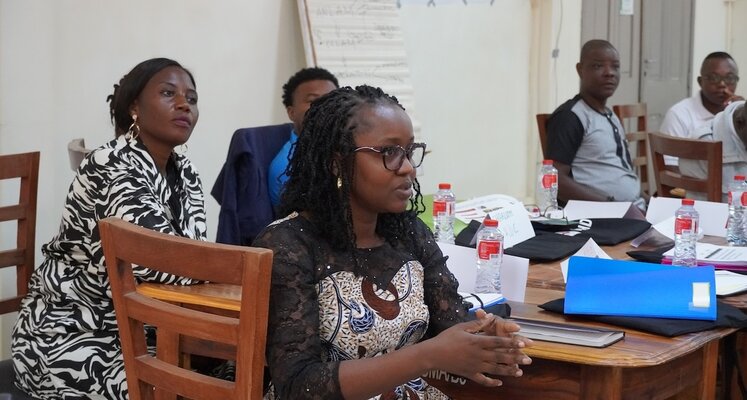
Advancing capacity development across the Sahel and West Africa
Over the past five years, the Sahel region has seen a steady rise in and geographic spread of the use of improvised explosive devices (IEDs).
HIGHLIGHTS
OUR WORK AROUND THE WORLD
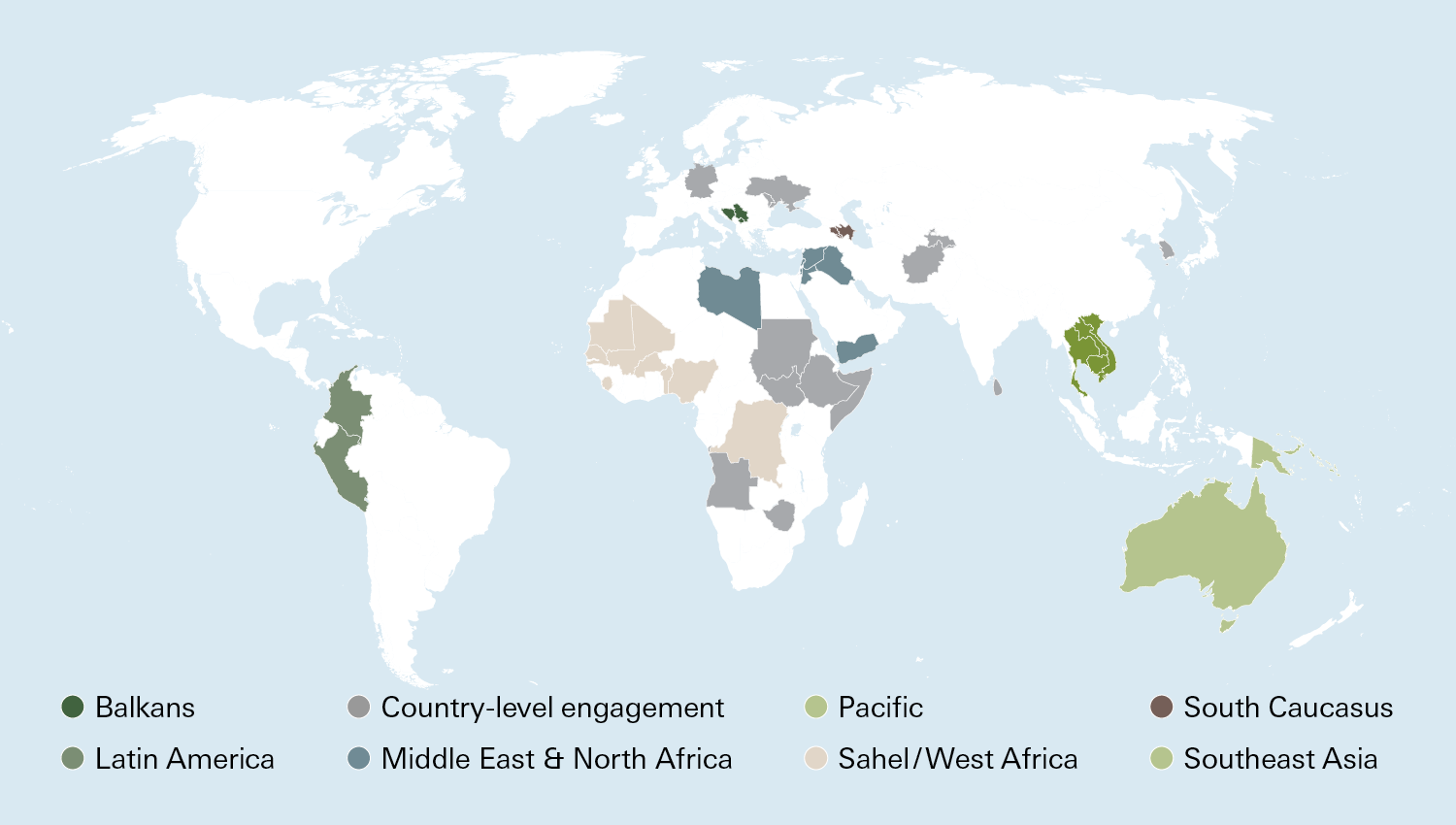
*This map is for illustrative purposes and does not imply the expression of any opinion on the part of the GICHD concerning the legal status of any country or territory, or concerning the delimitation of frontiers or boundaries.
We work with and for partners around the world.
We share information and expertise and provide training through long-term partnerships with national and local authorities, donors, the United Nations, other international and regional organizations, NGOs, operators, companies, and academia.
Our Regional Cooperation Unit coordinates efforts at the Centre, promoting dialogue, knowledge exchange, and cooperation in eight regions: the Balkans, East Africa, Latin America, the Middle East and North Africa, the Pacific, the Sahel and West Africa, the South Caucasus, and South-East Asia.
2025 RESULTS IN A NUTSHELL

1
Multilateral processes are informed by evidence and supported by expert advice
- 8 multilateral processes informed/supported for the development and implementation of legal and political commitments
Arms Trade Treaty, APMBC, Convention on Certain Conventional Weapons, Convention on Cluster Munitions (CCM), European Union Working Party on Conventional Arms Exports, Global Framework for Through-life Convention Ammunition Management, Regional Centre on Small Arms in the Great Lakes Region, the Horn of Africa, and Bordering States, OSCE - 2 intersessional meetings organized (APMBC, CCM)
- 14 extension requests reflect GICHD inputs
4 CCM (Afghanistan, Lebanon, Mauritania, Somalia); 10 APMBC (Angola, Cambodia, Colombia, Dem. Rep. of the Congo, Ecuador, Ethiopia, Nigeria, South Sudan, Türkiye, Zimbabwe) - 17 invitations to present at official meetings
- 13 interventions to Convention meetings
- At least 52 references to GICHD’s substantive support; 10 references to GICHD’s logistical support

2
National responses are framed by strategies, regulated by up-to-date standards, and enabled by information management
- 2 strategies reviewed:
Sri Lanka, Yemen - 2 strategy developed:
Moldova, Ukraine - 4 strategies implemented:
Germany (the German Federal Foreign Office), Moldova, Sri Lanka, Ukraine - 3 International Mine Action Standards revised; 1 Technical Note for Mine Action developed; 6 modules of the International Ammunition Technical Guidelines (IATG) reviewed
- 2 national mine action standards reviewed:
Peru, Ukraine - 11 chapters of national mine action standards revised
Afghanistan - 8 technical guidelines reviewed and developed
Palestine - 2 countries established an information management capacity
Iraq, Libya - 4 countries/territories established an information management system
Armenia, Kosovo, Senegal, Serbia

3
Operations are implemented safely, effectively, and efficiently
- 3 countries with improved through-life ammunition management capacities
Bosnia and Herzegovina, Moldova, Ukraine - 3 countries supported to establish a well functioning and fit-for-purpose ammunition TLM capacities
Jordan, Peru, Sierra Leone - 4 baseline assessment on ammunition TLM capacities:
Gambia, Kazakhstan, Peru, Ukraine - 1 baseline assessment and 1 work plan delivered to support enhancing operational capacity
Colombia

4
Gender and diversity are mainstreamed, and equality and inclusion promoted in explosive ordnance risk reduction
- 11 countries/territories supported to improve their gender and diversity capacity
Colombia, Iraq, Lebanon, Libya, Palestine, South Sudan, Sudan, Syria, Ukraine, Vietnam, Yemen - The GICHD organized 65 events, with 2,764 participants
34% of women across all events
17% local partners and 51% of national partners across all events
76% of people from affected countries across all events

5
The impact of explosive ordnance risk reduction is enhanced through connections with global agendas
- 3 countries connected EO risk reduction and global agendas in national strategies with the GICHD’s support
Ukraine, Vietnam, Republic of Korea - 1 region connected EO risk reduction and global agendas
Pacific
PERFORMANCE REPORT
To dive deeper into our work of last year, check out our 2025 Performance Report which is a comprehensive report of all our activities, based on our results-based management (RBM) system.
FINANCE
All amounts in CHF
TOTAL CONTRIBUTIONS
21,026,209
TOTAL INCOME
21,135,380
TOTAL DIRECT EXPENDITURES
20,880,732
TOTAL EXPENDITURES
21,135,380
Direct Expenditures
| Personnel expenses | 13,945,801 |
| Travel costs | 1,208,601 |
| Professional fees | 1,623,815 |
| Publications & outreach | 182,414 |
| ICT & Furniture | 812,364 |
| Events | 1,482,914 |
| Administrative & running costs | 1,218,872 |
| In-kind expenditures | 405,951 |
DONORS
The GICHD is thankful to all contributors who make its work possible. In 2025, the Centre benefited from core contributions, project funding and in-kind support from the following governments and organizations.











Funds were received from the Federal Department of Defence, Civil Protection and Sport (DDPS), the Federal Department of Foreign Affairs (FDFA) and its Peace and Human Rights Division, and the Swiss Agency for Development and Cooperation (SDC).