
Just released
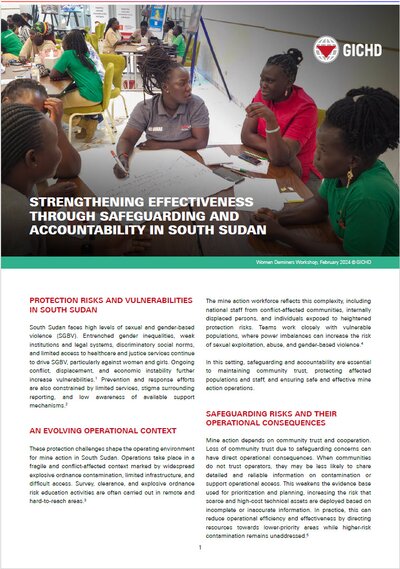
Strengthening effectiveness through safeguarding and accountability in South Sudan
South Sudan faces high levels of sexual and gender-based violence (SGBV). Entrenched gender inequalities, weak institutions and legal systems, discriminatory social norms, and limited access to healthcare and justice services...
- Available in English
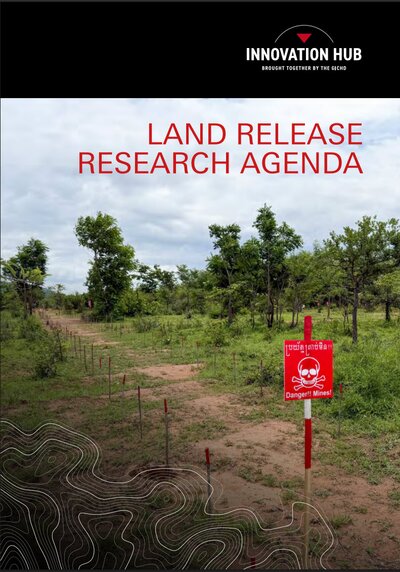
Land Release Research Agenda
Research agendas, developed under the Mine Action Innovation Hub, serve as practical guides that outline key research needs and provide stakeholders with an evidence-based foundation for setting research priorities. This edition...
- Available in English
ERW Contamination in the Pacific Islands
The legacy of explosive remnants of war (ERW) has affected the daily lives of Pacific Islanders for more than 70 years. ERW contamination in the Pacific stems from conflict between the Allied forces and Japanese forces during...
- Available in English
GICHD Linguistic Outreach Programs
The Geneva International Centre for Humanitarian Demining (GICHD) introduced linguistic outreach programs (LOP) to provide mine action training and information in multiple languages. The LOP also promote communication between...
- Available in English
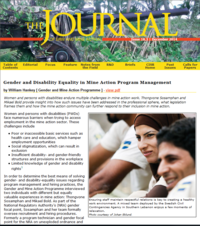
Gender and Disability Equality in Mine Action Program Management
Women and persons with disabilities endure multiple challenges in mine action work. Thongvone Sosamphan and Mikael Bold provide insight into how such issues have been addressed in the professional sphere, what legislation frames...
- Available in English
Outcomes of GMAP Work to Promote Gender Mainstreaming in the Mine Action Programmes of Afghanistan and South Sudan
This report documents the outcomes of GMAP's work in Afghanistan and South Sudan following the 2013 strategy development process.

- Available in English
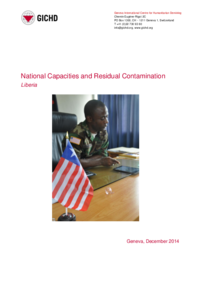
National Capacities and Residual Contamination | Liberia
This case study forms part of a broader GICHD study on national capacities and residual contamination and is based on both desk-top research and findings from a GICHD mission to Liberia in March 2014. The purpose of the report is...
- Available in English
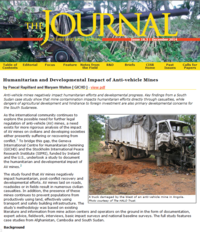
Humanitarian and Developmental Impact of Anti-vehicle Mines
Anti-vehicle mines negatively impact humanitarian efforts and developmental progress. Key findings from a South Sudan case study show that mine contamination impacts humanitarian efforts directly through casualties, while dangers...
- Available in English
National Capacities and Residual Contamination | Nicaragua
This case study forms part of a broader GICHD study on national capacities and residual contamination and is based on both desk-top research and findings from a GICHD mission to Nicaragua in December 2013. The purpose of the...
- Available in English
Capacidades nacionales y contaminación residual | Nicaragua
El presente estudio de caso forma parte de un estudio más amplio del Centro Internacional de Desminado Humanitario de Ginebra (CIDHG) sobre las capacidades nacionales y la contaminación residual, y se basa tanto en una...
- Available in Spanish
Bridges between worlds | Chairperson's Summary | April 2014
Bridges between Worlds was a global conference sponsored by the European Union that addressed fundamental questions about the place of landmine victim assistance in other domains, such as the worlds of disability, heath care,...
- Available in English